

The following Material Mode post is by Julie Sandy Boyle; previously the archivist/librarian at the New York School of Interior Design, Julie joined SPARC’s team in April 2025. With a decade of experience in scenic and prop design, as well as her background in architecture, exhibition, surface design and interior design archives, Julie brings a unique perspective to FIT’s manuscript collections.
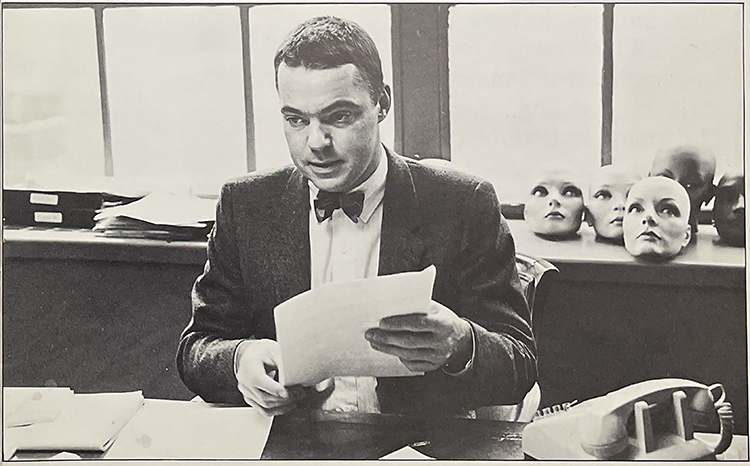
A few months ago, in the course of an ongoing project working to survey and describe the manuscript holdings for SPARC’S new catalog of finding aids, I stumbled across a fascinating little one-box visual display design collection, the Colin Birch papers, SC.405. Birch’s papers stood out as a microcosm of how our archives exist in the world—each collection its own unique pool of ‘stuff’, simultaneously in conversation with other SPARC material, which all in turn weave together to illustrate a larger story about how fashion and culture have developed over the centuries.
Born in Birmingham, England, Birch moved to the US in 1970 and became an interior display director at Saks Fifth Avenue under Henry F. Callahan, then corporate director of visual presentation at Bonwit Teller in the mid 1970s. In 1978 Birch started his own display and interior design company, Colin Birch Associates—with international clientele such as Estee Lauder and Missoni—and then in 1981 he became vice president of visual presentation at Bloomingdale’s, the period that his archival material documents. His career was cut short by his untimely death in 1988 at the age of 38.
The more I delved into this small but rich collection and researched who Colin Birch was, the more I realized not only how influential he was in the world of display design, but how much power major department stores wielded at the time, through visual marketing and beyond, across a wide spectrum of fashion and design industries. This will become apparent as we look more closely at the different types of material in Birch’s collection.
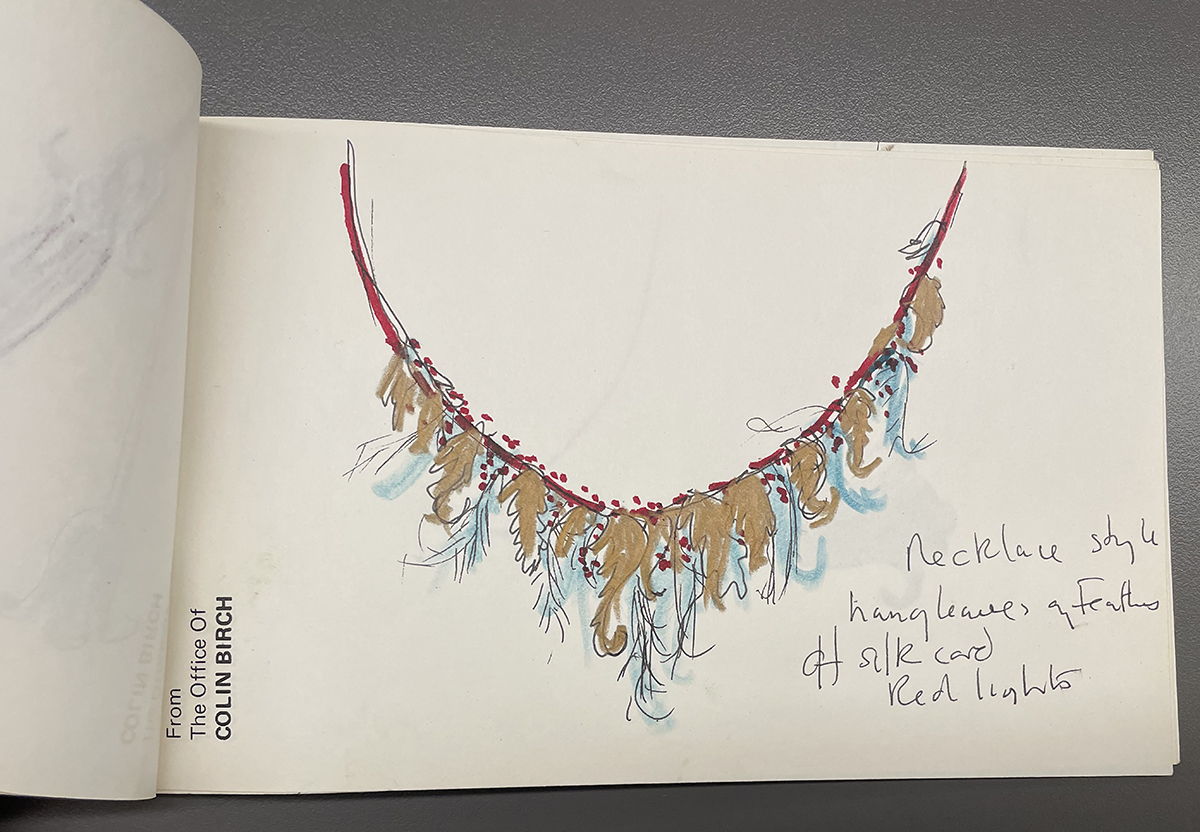
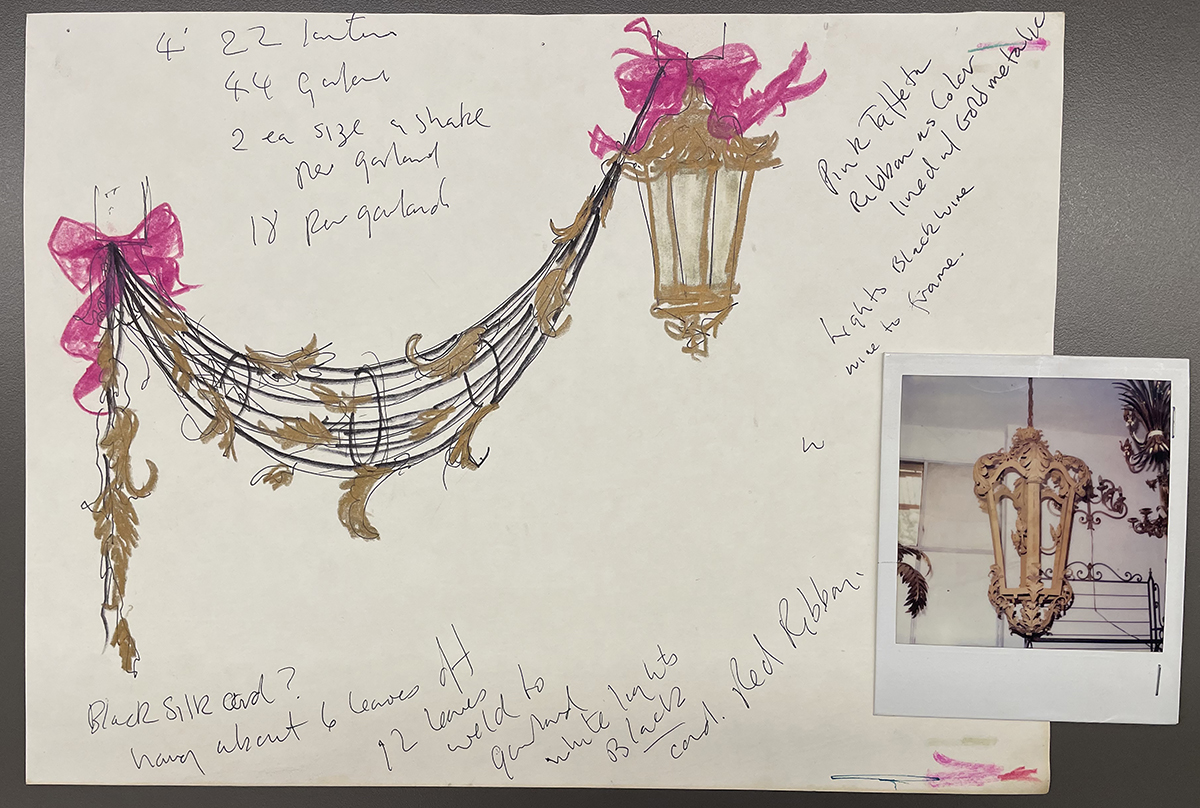
Folder 1 of the collection consists of research and design sketches, mostly for Christmas holiday windows from 1984 and 1985. Some are rough and dynamic, jotted on random note paper or backs of envelopes, lines and concept notations running into the glue seam and off the edges of the page, others painted or more formally drafted construction drawings for display fixtures—all design process documentation ‘gold’! This kind of material is so valuable in the context of an archival collection, because it gives raw access to the thought process of the designer who created it. Many of our manuscript collections at FIT include similar design process sketches, where you can clearly see the options the designer rejected and the ‘notes to self’, as well as which elements made it through to the realized product or finished look.
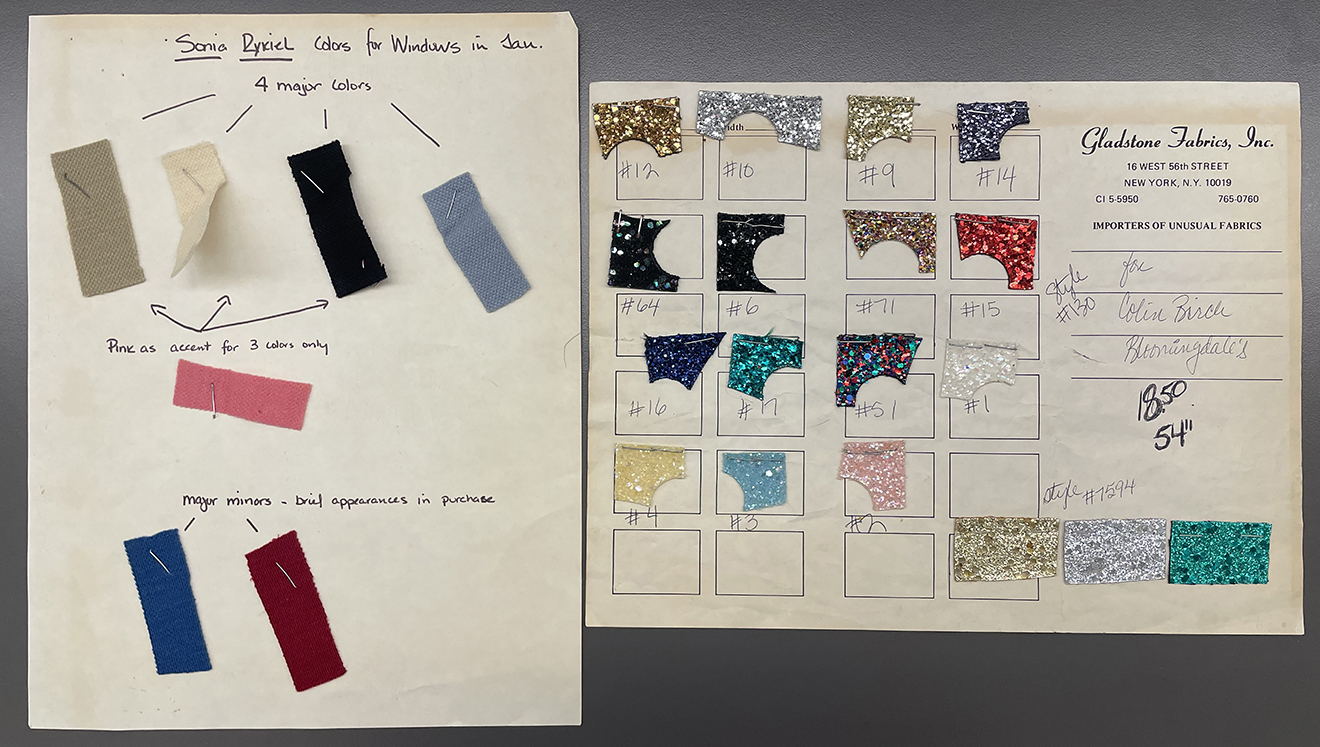
In this same folder are textile swatches, vinyl samples and product sample sheets. Materials are the bread and butter of display artists, from knowing which material is structurally suited to a project, to the joy of being the first to ‘discover’ an innovative new material, to finding ways to transform more classic, mundane materials through different, sometimes unusual, applications. It is essential to develop a strong network of relationships with vendors, material designers and fabricators; this is true not only in the world of exhibition and display, but also in other 3-D art forms such as fashion, interior design, packaging design, etc. Colin Birch’s success likely hinged in part on his deep contact list and the relationships he forged.
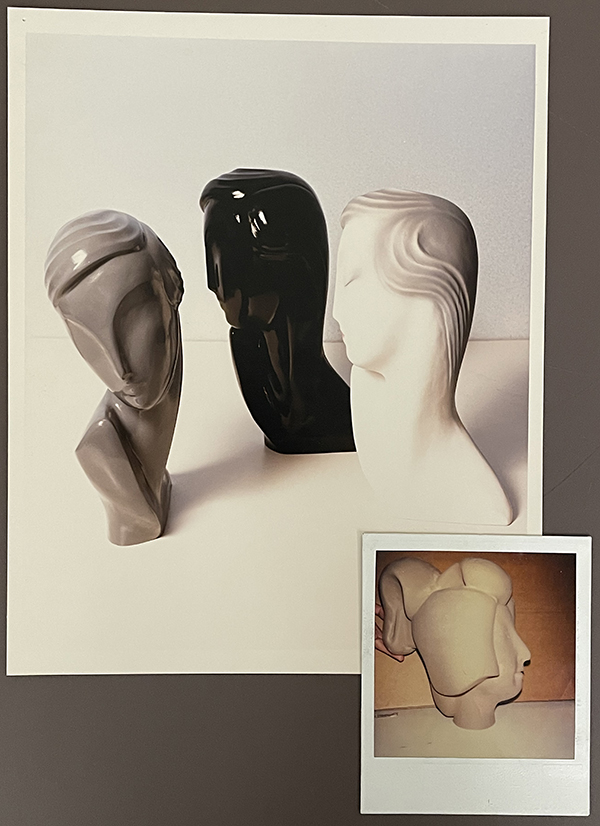
Also essential for any display designer is careful attention to the mannequins. Many display artists design their own mannequins, customized to the exact look and feeling they are aiming to evoke. Gene Moore famously used actress Audrey Hepburn as a mannequin model—prints of the pictures he took of her for that purpose can be found in a recently-acquired manuscript collection, Gene Moore photographs SC.544. In his book “The American Store Window” published in 1978, author Leonard S. Marcus says that Colin Birch “…preferred at Bonwit Teller to use abstract mannequins. The figures allowed the clothes to be seen on a sculptural form that leaves the wearer’s identity a little ambiguous, to be decided by the viewer” (p.95). Both reference photographs and images of realized displays found throughout Birch’s papers show the types of mannequins he was employing at Bloomingdale’s. Another recently- acquired manuscript collection that documents mannequin design and marketing in the later 20th century and speaks directly to Birch’s material is the Sara K. Schneider papers, SC.547 (unprocessed at the time of writing but available in person by request).
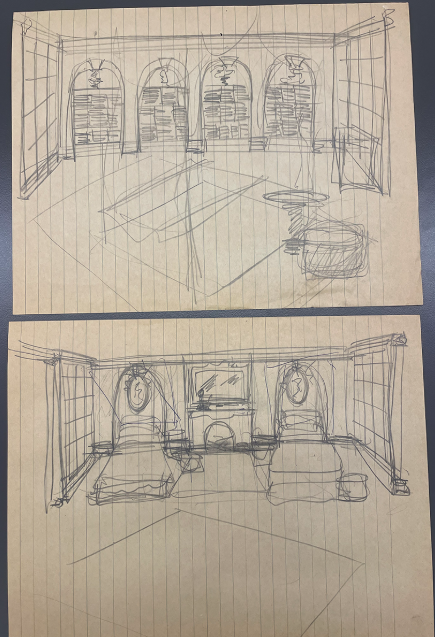
In addition to his professional display work, Birch took on some interior design projects in the late 1970s and early 1980s, designing the penthouse apartment for Bonwit Teller’s board chairman John Schumacher, as well as apartments for Bonwit Teller (and then Bloomingdale’s) president Cal Ruttenstein. I found a few interesting unlabeled interior design sketches in the collection which may be related to those projects, or might be sketches for potential in-store display elements:
Another folder in Birch’s collection, originally labeled ‘Thank you notes’, was chock full of business and personal cards and correspondence. Some cards are from somewhat expected correspondents—chairman of Bloomingdale’s Marvin S. Traub, Henry F. Callahan—while others are from top fashion designers such as Calvin Klein, Bill Blass, Donna Karan and Betsey Johnson, personally thanking Birch for how great he made their designs look in the Bloomingdale’s windows. A folder originally labeled “Write-ups and awards” contains a full issue of the Tobé Report (record for FIT Library’s run of Tobe Reports here) from Dec 10, 1985, with a 3-page article titled “A Salute to Bloomingdale’s Window Dressing!”. It was when looking at these materials and more in juxtaposition that the true influence of the visual merchandising director struck me, and the importance of the web of relationships between designers, department stores, and the display managers who control what gets put in the window and how it is presented to the public. There is so much marketing power in the visual presentation, especially pre-internet when stores and designers relied so heavily on foot traffic at brick-and-mortar stores to push forward products. Store display is part of the fashion life cycle, which circles from initial design concept, to rendering, to fabrication, to marketing, to merchandising, and then back around for the next season. SPARC has multiple collections of window display photographs spanning the 20th century (B.Altman window display photographs SC.191, Views and Reviews from the Retail Reporting Bureau SC.291, Department store window photographs SC.309, Orbach’s store window photographs SC.310) that tell similar stories of how designers, stores, and the industry as a whole worked together to drive this cycle time and again.

Other folders in Birch’s papers contain press clippings, articles and photographs surrounding Bloomingdale’s international culture campaigns of the early 1980s, which were the brain child of Marvin S. Traub. Birch was most involved in the Portugal and Japan series of displays, even embarking on a research trip to Japan in 1984, snapshots of which are in the collection. I was struck by yet another ‘big picture’ connection with other SPARC manuscript collections, regarding how much sway big department stores had over design and culture in the later 20th century, not just in New York City, but as trendsetters and even cultural ambassadors on a global scale. The Lord & Taylor collection (SC.125), B. Altman & Co. collection (SC.397), and Bonwit Teller scrapbooks (SC.391), as well as multiple collections containing department store catalogs and oral histories with individuals who worked for these influential stores, each tell their own unique facets of this story.
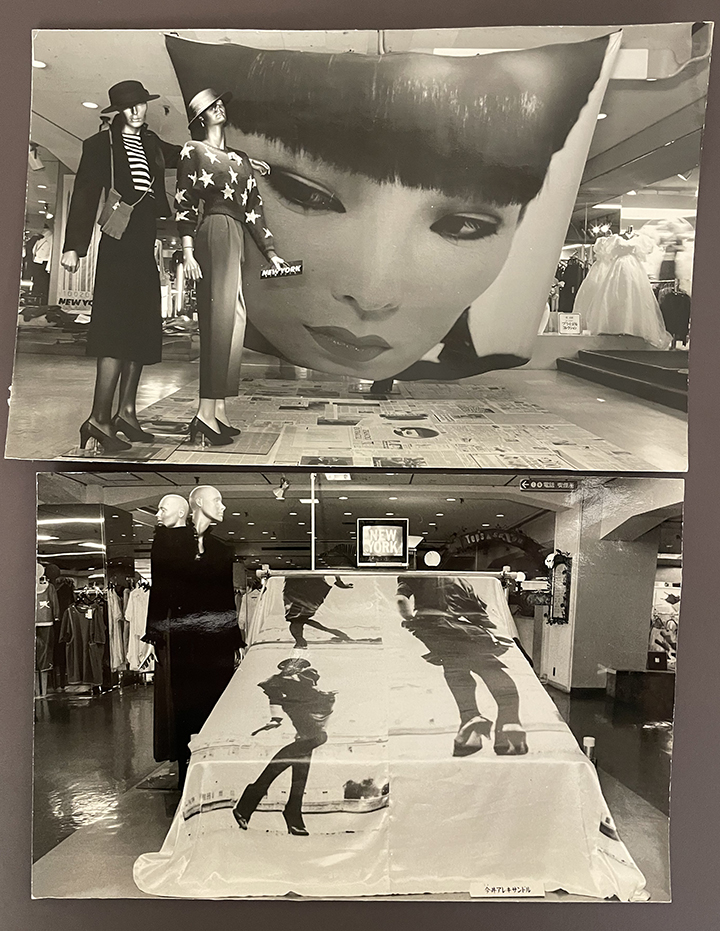

Colin Birch’s all-too-brief yet important career still resonates today. Written a decade before Birch died, “The American Store Window” puts it in a nutshell: “Colin Birch made what were among the most intelligently realized and adventurous graphic statements seen in New York display” (p.93). Birch is credited by many as having created “minimalist” displays, which removed separating dividers between windows, stripped any decorative architectural elements and turned the windows into large, spare, white-vinyl-lined spaces where one or two mannequins would be the visual focus with only a few, highly curated, props—a style which (to quote Marcus again) is “more merchandise-oriented” and which unapologetically highlights “the most basic material in window display: the space itself” (p.93). Birch’s influence also lives on quite literally at FIT—after his death his friends and family endowed one of the windows on 7th Avenue as the Colin Birch Memorial window, which is still in use by Experience and Exhibition Design students today.
Book a research appointment at SPARC if you would like to explore this fascinating collection further!
Dig Deeper:
- Feigenbaum, E. (2024, March 22). The touchstone of the brand and the cornerstone of culture. Visual Merchandising and Store Design.
- jdavidv9. (2021, February 5). “Visual merchandising” vs. “Display design” from the Archives! Visual Merchandising & Display Design.
- Kron, J. (1977, September 8). The Penultimate Penthouse / Posh Penthouse: Sleekness in Triplicate (published 1977). The New York Times Archives.
- Marcus, L. S. (1979). The American store window. Whitney Library of Design.
- The New York Times Archives. Colin Birch, retailing executives, dies at 38 (published 1988).
- The New York Times Archives. (1978, January 26). Home beat (published 1978).
- Taylor, A. (1977, November 28). They find right face then create a mannequin to resemble (published 1977). The New York Times Archives.