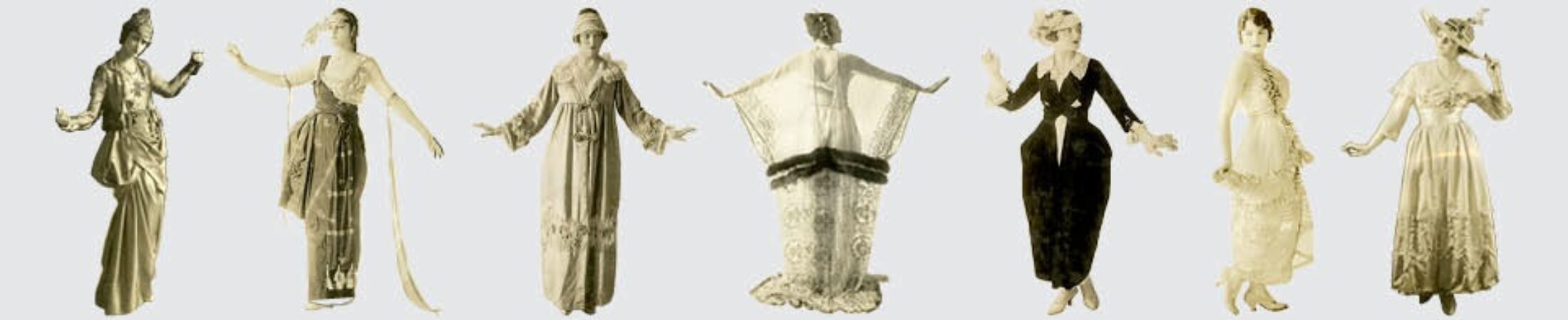
Steichen & Poiret: the first fashion photographs?

Many scholars cite the emergence of modern fashion photography to the April 1911 issue of Art et Decoration, which features the designs of couturier Paul Poiret as photographed by famed photographer Edward Steichen.

Certainly, these images are not the earliest fashion photographs—our department contains examples from La Mode Pratique dating to 1892—but the presentation of garments in these is largely straightforward, in the tradition of the fashion plate, which for centuries had provided illustrations so detailed one’s dressmaker or tailor could recreate the look down to the last button.  Poiret broke new ground in fashion illustration in 1909 with his collaboration with artist Paul Iribe on Les Robes de Paul Poiret, a deluxe album of Poiret’s couture designs.  Iribe’s illustrations concerned themselves less with line-for-line renderings and instead focused on conveying the spirit or mood of the dress, for, in Poiret’s words “A garment is like a good portrait—the expression of a spiritual state and there are robes [dresses] that sing the joy of living as others that herald tragic ends.”

In a similar vein, Steichen’s photographs of Poiret’s designs are moody and atmospheric.  They evoke a certain mode of being and lifestyle, a modern, artistic approach to the presentation of clothing that seeks to obfuscate the inherent commercialism of fashion photography.

Following the rarely-seen spread featured here, Steichen would not make another fashion photograph for another ten years. In 1922, he accepted the invitation of American publishing magnet Condé Nast to join the staff of both Vanity Fair and Vogue, where he replaced another of fashion photography’s legendary forefathers Baron Adolph de Meyer.

Thank you to Antoine and Nicolas of Diktats for hand-delivering this issue to us from Paris!

Posted in Fashion, Fashion History, Fashion Illustration, Photography, Publishing | Tagged , , , , , , , , , , , , | Leave a comment

Bare Beauties

During the 1920s, publishers circumvented the laws concerning the publication of nude photos by ostensibly purposing them “FOR ARTISTS ONLY.” “While this magazine is of general interest, particular stress is laid upon the fine arts and crafts; and an especial appeal is made to artists, designers, architects, drawing teachers, photographers, art supervisors, curators of museums, draftsmen, mural decorators, cartoonists, crafts workers, illustrators as well as to physicians and surgeons…To the pure all things are pure, is an old saying.  But it’s just as true as ‘Evil to him to evil things’  The Bible tells us that ‘As a man thinketh in his heart, so is he.’ ”


The women that appeared in these magazines were frequently professional dancers, actresses and showgirls, who were looking to promote a specific production in which they appeared.  While, no doubt, these magazines were enjoyed by a wide variety of readers in their own time, today they serve as exquisite records of the ideal figure of the Art Deco era.

Of special note to fashion historians, this article discussing hemlines, from 1928.


Posted in Costume, Design, Fashion History, Photography, Publishing | Tagged , , , , , , , , , , , , | 1 Comment

Muriel King and Gone With the Wind

King’s proposed design for Scarlett’s ‘curtain dress’

Keren Ben-Horin’s recent post on one of our favorite blogs, ON PINS AND NEEDLES, has inspired us to speak about a little more about the American couturière Muriel King and her work in Hollywood. King established a successful couture house in New York City during the early 1930s—at the height of the Great Depression.  Her clients included some of the best-dressed American socialites including several women of the Morgan and Whitney families.  In the wake of the acclaim she received for her couture designs, Hollywood came calling, and King relocated briefly to California. She designed costumes for several films including Sylvia Scarlett (1935), Stage Door (1937), and Cover Girl (1944), which starred —respectively— Katharine Hepburn, Ginger Rogers and Rita Hayworth.

A little known fact about King’s work in film, however, is that she was under consideration to design the costumes for the 1939 mega-blockbuster, Gone With the Wind.  Ultimately, the job went to Walter Plunkett —Hollywood’s go-to for historic costume dramas —despite the fact that author Margaret Mitchell lobbied hard for King.

The Muriel King sketch collection (x3) held by SPARC contains some beautiful examples of King’s original sketches for the designs she proposed for Gone with the Wind.

LEFT: Plunkett’s design as seen in the film.  RIGHT: The actual costume worn by Vivien Leigh in the film, which was exhibited recently by the Victoria & Albert Museum in London.


Posted in Costume, Fashion History, Film | Tagged , , , , , | Leave a comment

The Muppet Show Style Book

One of the staff favorites in the department isn’t necessarily due to its precious nature, but rather its nostalgia…

The Muppet Show Style Book was created in 1979, three years after the launch of  popular television show, by Jim Henson & Associates, Inc.: “This book of style sheets and character personality descriptions has been compiled to assist licensees in properly depicting the MUPPET SHOW characters.” Drawings in the book delineate matters such as the relative scale of the characters to one another and provide views of the characters from multiple angles.  Further details on each character tells us that Miss Piggy always wears PMS 270 blue eyeshadow, while Janice should always be dressed in a pale blue denim skirt with a green feather belt.

While the holdings of the department contain a wealth of information on fashion, costume and textile design, we also collect materials that support almost every curricula offered at FIT, including toy design.  

SCHMORD-DA-BORD-DA-BORD-A-BORDY!

Posted in Costume, Design | Tagged , , , | Leave a comment

Fashion Designers A-Z: The Collection of The Museum at FIT

The much anticipated publication featuring highlights from The Museum at FIT’s costume collection is finally here!  Published by Taschen, with a forward by Suzy Menkes, and text by The Museum at FIT’s Director Valerie Steele, the initial copies of the title are gorgeous limited-editions housed in lucite display cases.  Six ‘Designer Editions’ are available, featuring fabric covers selected by Akris, Etro, Stella McCartney, Missoni, Prada and Diane von Furstenberg.

Profiles of one-hundred and twenty-three prominent 20th and 21st century fashion designers are interspersed with images of the Museum’s holdings of their work.  Steele contributes additional essays on the history of exhibiting fashion in a museum setting as well as a history of the Museum at FIT itself. Additional contributions by MFIT staff Fred Dennis, Jennifer Farley, Colleen Hill, Melissa Marra and Patricia Mears.  The trilingual title is published in English, French and German.

Posted in Costume, Fashion, Fashion History, Textiles | Tagged , , , , , , , , | Leave a comment

The Extraordinary Life of Gerda Wegener

The fact that Danish artist Gerda Wegener was one of the few female artists to find commercial success in Paris during the teens and twenties, is perhaps one of the least intriguing aspects of her extraordinary life.  Born in Denmark in 1885, Wegener studied art at the Academie des Beaux-Arts in Copenhagen.  In 1912, she relocated to Paris with her former teacher and husband, the painter Einar Wegener.  Gerda found success almost immediately working as an illustrator for fashion magazines including La Vie Parisienne and the ultra exclusive Journal des Dames et des Modes, the limited-edition fashion journal intended for artists, intellectuals and high society.  Gerda’s work in Journal appeared alongside that of leading illustrators of the Art Deco period, including George Barbier, Charles Martin, Umberto Brunelleschi and Georges Lepape. Commissions poured in for Wegener, who also worked as a portrait painter and illustrator for numerous volumes of erotica that were produced in Paris during this period—despite the fact the subject of sex was largely considered taboo for women.  This is but one of the reasons that Wegener’s exquisite and tasteful renderings of female sexuality are now highly sought after by collectors of erotica.

Gerda’s willingness to explore themes of love, mystery and sex were undoubtedly inspired and indulged by her relationship with her husband.  When, one day, a noted actress failed to show up for her portrait sitting, her husband donned a dress and sat for the session in the actress’ absence.  This was the birth of ‘Lili Elbe,’ Einar’s feminine alter-ego that became a serious source of delight and amusement for the couple who often went out in public together dressed as best girlfriends.  The concept of gender began to weigh heavily on Einar, who came to feel he was meant to live openly as a woman, and in 1930, he became one of the first recorded recipients of a gender reassignment surgery.  Although, the King of Denmark annulled Gerda and Lili’s marriage, the two remained quite close until Lili died in 1931, as the result of a failed uterine transplant. Gerda remarried for a short period before returning to Denmark where she died in 1940.

Today, Wegener’s work has fallen into relative obscurity, despite a small cult following and the inclusion of many of her portraits in French museum collections.  Wegener’s illustrative style was highly expressive and her depictions of women are always spirited, wether they be innocent ingenues or seductive sirens, one can detect a sense of intellect and mischief simmering just below the surface of their delicate demeanor. 

These pochoir plates are from Journal des Dames et des Modes in 1914, and evidence her status as a luminary of the Art Deco period, who deserves the same accolades as her better known contemporaries, such as Barbier, Lepape, Erté, and Paul Iribe.


Posted in Fashion History, Fashion Illustration, Uncategorized | Tagged , , , | 1 Comment

The Frances Neady Collection of fashion illustration


A series of three fashion illustrations by famed fashion illustrator, and FIT alumni, Antonio Lopez.

This year, 2013, marks the 30th anniversary of The Frances Neady collection of fashion illustration, a unique collection of the works by prominent fashion illustrators from the 1920s to present.  Established in 1983 as a memorial to Frances Neady, professor of fashion illustration for more than forty years at both the Parsons School of Design and the Fashion Institute of Technology, the original nucleus of forty-five drawings has now grown to more than 300 works

Many of the works in the collection continue to be donations by the illustrators themselves—many of whom were former Neady students.  Standouts in the collection include works by Antonio, Bouché, Eric, Tod Draz, and Dorothy Hood among many, many other talented artists of fashion.

Posted in Fashion, Fashion Illustration | Tagged , , , | 1 Comment