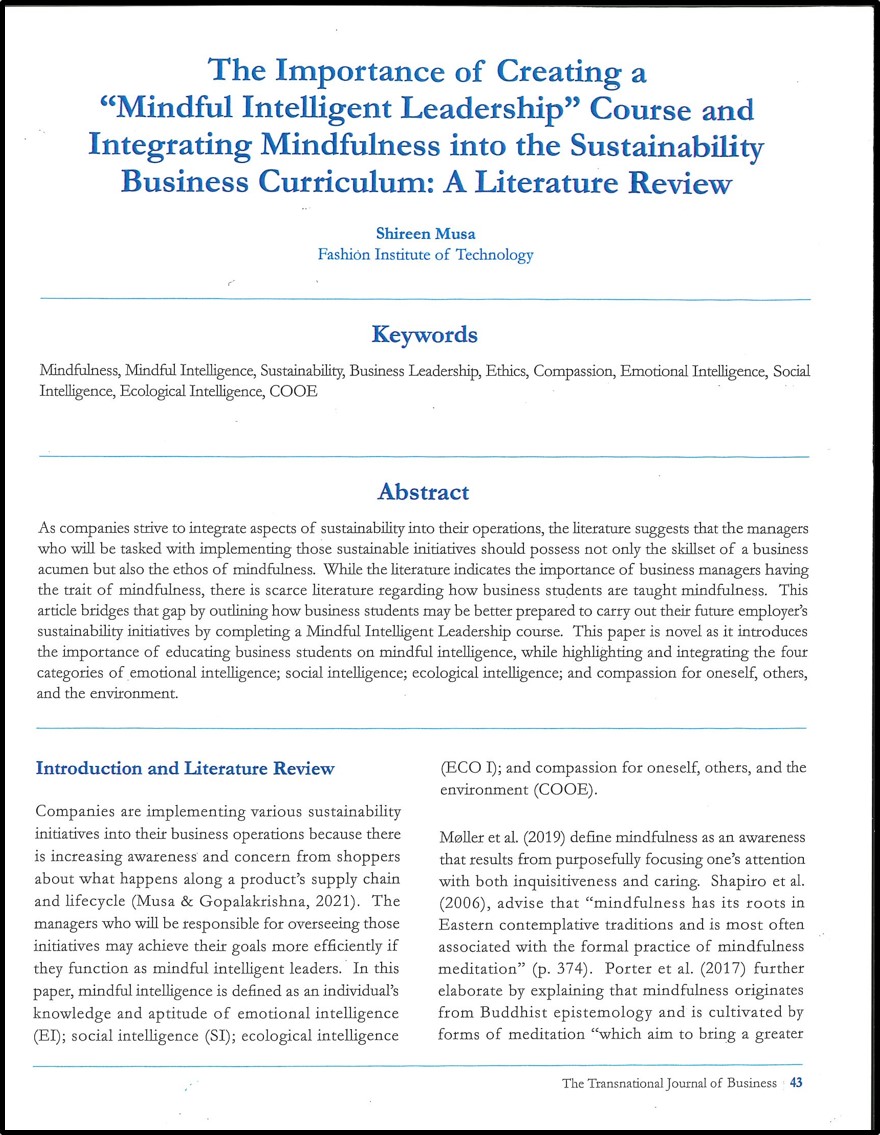
To read the full article titled The Importance of Creating a “Mindful Intelligent Leadership” Course and Integrating Mindfulness into the Sustainability Business Curriculum: A Literature Review, click on the below link for the PDF.
International Trade and Sustainability Issues by Dr. Shireen Musa
To read the full article titled The Importance of Creating a “Mindful Intelligent Leadership” Course and Integrating Mindfulness into the Sustainability Business Curriculum: A Literature Review, click on the below link for the PDF.
Comments are closed.
The article informed about the addition of a Mindful Intelligent Leadership course to business education in order to better equip students for the growing emphasis on sustainability in corporate operations. It highlights the significance of mindfulness, emotional intelligence, social intelligence, ecological intelligence, and compassion in shaping the next generation of business leaders who can advocate for sustainable business practices.
After reviewing the article, I gained valuable insights into the potential benefits of a Mindful Intelligent Leadership course for business students in facilitating the implementation of sustainability initiatives within their future professional endeavors. The course encompasses emotional intelligence, social intelligence, ecological intelligence, and compassion for oneself, others, and the environment. This comprehensive approach equips students with the knowledge and skills necessary to effectively drive sustainable initiatives within their future organizations.
Additionally, the course fosters awareness of cognitive, emotional, and behavioral patterns, while promoting compassion, essential attributes for individuals engaged in sustainable business practices. Upon completion of the course, students can cultivate the abilities required to supervise, inspire, and mentor colleagues from diverse cultural backgrounds, engage in negotiations, and support the development, sales, and marketing of sustainable products and services.
Furthermore, the Mindful Intelligent Leadership course encourages students to comprehend the environmental and societal impacts of products and services, fostering a shared awareness of the interconnectedness between human behavior and its effects on natural systems. This holistic understanding empowers students to make informed decisions and contribute to sustainable business practices within their future organizational settings.
Overall, I believe the Mindful Intelligent Leadership course equips International Trade and Marking students to embody mindful intelligence, emotional intelligence, social intelligence, ecological intelligence, and compassion, thereby enhancing their capability to champion and implement sustainable initiatives within their future professional pursuits.
This article captivated me with the proposal of linking Mindfulness with Sustainability in business practices. The ideas exposed regarding the creation of a “Mindful Intelligent Leadership Course” are strongly related to the ITM major. This program prepares us to enter a global industry that operates in a world of constant economic, political, and social change while also encourages us to being good corporate citizens. Throughout my time within the program, I’ve been able to take classes that focus on Corporate Social Responsibility, Ecology and Business Ethics that have increased my awareness about unethical practices affecting our environment and society as a whole. In these courses we are able to contrast good and bad companies’ practices and understand the different approaches they take to face challenges such as climate change. Yet, I believe that the “Mindfulness” element is either missing or not as strong as it should be within the curriculum of these courses.
Dr. Musa’s proposal of a “Mindful Intelligent Leadership course” that dives deep into the four attributes; “emotional intelligence (EI); social intelligence (SI); ecological intelligence (ECO I); and compassion for oneself, others, and the environment (COOE)” (Musa) could be greatly beneficial for students. With the increased awareness in conscious consumption and the search more ethical business practices, companies have started to implement sustainability initiatives to keep up with the current changes and challenges. This course could help prepare students to become the leaders that society needs now. Leaders that are versed in knowledge about sustainable practices but that are also prepared to link knowledge with compassion in order to make more informed decisions that will benefit the company, the environment and society as a whole.
The paper explains the importance and impact of employers giving their employees a leadership course and why consumers have become more mindful of their own sustainability actions. Many business students are not taught an in-depth understanding of what mindfulness is and how to implement it. Employers teaching their employees what mindful intelligence is will not only help their company/business, but it will also help the employees apply what they learn to future business transactions with foreign and domestic companies. The four categories of emotional intelligence are social intelligence, ecological intelligence, and compassion for oneself, others, and the environment. Social intelligence is the ability to have a primal empathy for others and sensing non-verbal emotions. Emotional intelligence includes the ability to know your own emotions and manage them, motivate yourself, and recognize various different emotions in others. Ecological intelligence involves the ability to apply social and emotional intelligence to natural ecosystems and show empathy for all different life forms. Compassion for oneself, others and the environment combines the skillsets of the first three categories of emotional intelligence and applies them to real world scenarios where all three skill sets would be needed.
The paper related to the International Trade and Marketing major because working with foreign and domestic businesses as a professional, you need to be able to exhibit all four categories of emotional intelligence. Working with a foreign business includes different barriers such as language barriers, nonverbal communication, and cultural and political differences that you will need to be able to overcome to have a successful business transaction. Social intelligence is being able to do research on the country to understand any cultural differences or traditions that you may not be familiar with. Emotional intelligence involves you being able to understand the other countries’ nonverbal communication and social traditions. Ecological intelligence would be applied to how you choose what factory and manufacturer to work with, as well as their business practices and ethical standards.
Having leaders is one of the most important things in the world. It is important in every aspect of life, but most especially in the workplace. Where schools already sometimes lack to provide students with skills they can actually use and apply once they move on into the workplace. Because of this lack, I believe that a Mindfulness Intelligent Leadership course is something that can greatly benefit in many ways.
In business, it is not only important to have technical business skills. It is just as important to have personal skills as well as leadership skills. The ITM program would greatly benefit from a class like this, because it will help students gain confidence and now how to manage others in the workforce. It is also a great way to encourage students to be bold business people and can help them excel in their careers.
The Importance of Mindful Leadership in Business Education
In this article written by Professor Musa, she argues that business education should incorporate training in mindfulness to develop well-rounded future leaders. Mindfulness can improve decision-making, problem-solving, and communication- all of which are crucial for success in business.
The four key elements of mindful leadership proposed were social intelligence (SI) or being able to understand and navigate social situations, emotional intelligence (EI) or being able to manage one’s own emotions and those of others, ecological intelligence (ECO I) or being able to understand and consider the environmental impact of business decisions, and compassion for oneself, others, and the environment (COOE) or a sense of empathy and concern for well-being
By integrating these elements into business curricula, universities can equip students with the skills to become ethical, responsible, and effective leaders. One key benefit of mindful leadership is emotional intelligence. Leaders who understand emotions can better identify and address interpersonal problems and needs. This leads to more ethical and empathetic responses, fostering a positive work environment and stronger relationships with clients and partners. This is particularly advantageous in international trade where verbal communication is not always the most available and exact. In addition, mindful leadership also encompasses social intelligence and ecological intelligence. Social intelligence allows leaders to navigate cultural differences and build strong relationships. Ecological intelligence ensures that businesses consider the environmental impact of their decisions and strive for sustainability.
While currently, there are no specific courses on mindful leadership in the ITM program at FIT, the program does incorporate many of these concepts. For example, courses such as global marketing address cultural sensitivity and ethical decision-making in the fashion industry, which is known for its social and environmental challenges. Unlike technical skills, mindful leadership qualities are a soft skill that can be more subtle and requires practice. By integrating these concepts into coursework, educators can raise students’ awareness of these important aspects of leadership and help develop the next generation of responsible and effective business leaders.
I found this paper extremely interesting, specifically through the way mindful intelligence is broken down and explained under the four categories of emotional intelligence, social intelligence, ecological intelligence, and compassion for oneself, others, and the environment; embodying such intelligence can shape consumerism, professional leadership roles, academia, and the environment. Ecological intelligence stood out to me, as this knowledge guides society to be mindful of sustainable decisions in regard to their impact on the environment which can alter not only individual actions and behaviors, but also widespread industry actions and behaviors, driving change extending to all natural systems (p. 45). Goleman is quoted which reads, “‘our inability to instinctively recognize the connections between our actions and the problems that result from them leaves us wide open to create the dangers we decry’” (p. 46). The inclusion of this statement is exceptionally powerful, as it not only supports the paper’s notion regarding the widespread benefits of mindfulness, but also highlights that if we fail to harbor a mindful perspective, we are likely to be a part of the extensive environmental and societal costs of irresponsible actions or unsustainably manufactured goods and services.
I feel this paper directly correlates to FIT’s IN 423 course due to the fact that the incorporation of the aforementioned categories of mindful intelligence can greatly benefit international marketing efforts. For our term project, I developed a marketing strategy that followed similar values to this study to effectively penetrate my target market where sustainability was a foremost concern. Evidently, such material learned from this paper can complement other business curricula, furthering the integration of mindful thinking into academia. Mindfulness can also support “societal and environmental stewardship” in various post-degree roles as a consumer, manager or leader, collaborator, negotiator, or marketer of goods and services (p. 47).
I like how this article dives in deep to what many companies lack of. In this capitalistic world we are taught to be working machines but not to empathize and communicate effectively with one another. I agree all majors and companies should offer this program to their employees and student’s because this is an invaluable lesson they can carry with them all throughout life. Not only at work, but also in school, in their Neighborhood/community, personally, family and relationships. These are challenges we face every day, and we can learn from them and make more positive choices which will lead to positive changes in this world. Which is what we currently need.
I can see how this program relates to our sourcing class and ITM major in general. You are constantly communicating with people from different ethnicities and cultures, learning about their current political status, environment, demographics, geography and history. This helps us connect more with people emotionally and effectively. We need this in the marketing area to help understand and connect with our consumers, but also as a leader. You must set an example for your employees, making sure they are working in a safe environment and getting paid fares wages. Being self-aware, and of your surroundings can help make better choices when dealing with supply chain. Making sure our products doesn’t harm communities and their land, where we are sourcing from, like polluting our water, soil, air and entire ecosystem in general. All of this also helps us educate consumers as well. This program is a great way to start that and make a positive change.
“The Importance of Creating a “Mindful Intelligent Leadership” Course and Integrating Mindfulness into the Sustainability Business Curriculum: A Literature Review” by Shireen Musa highlights the significance of introducing a course on ‘Mindful Intelligent Leadership’ and incorporating mindfulness into the sustainability business curriculum, with a focus on leadership development. This paper discusses various important aspects within the field of International Trade and Marketing. First of all, navigating the complexities of international trade and marketing requires effective leadership. This paper argues in favor of including mindfulness practices in leadership development programs. Developing qualities like self-awareness, emotional intelligence, and resilience through mindful leadership can improve decision-making and relationship-building abilities in the global business environment. Not only leadership, but also sustainability and corporate social responsibility (CSR) are becoming increasingly crucial factors in international trade and marketing. Businesses are anticipated to conduct themselves in an ethical and responsible manner, considering their impact on the environment and society. Engaging in mindfulness practices can help business leaders and marketers better grasp sustainability principles and make responsible decisions.
Mindfulness practices can also impact consumer behavior and marketing strategies in global markets. Marketers can use mindfulness principles to create brand experiences that are more authentic and meaningful, appealing to socially conscious consumers. Businesses can create stronger connections with their target audience and stand out in competitive global markets by incorporating mindfulness into their marketing strategies. Lastly, engaging in mindfulness techniques can improve communication and negotiation abilities across different cultures, crucial for succeeding in global business. Mindful leaders and marketers can build successful collaborations and business transactions by encouraging empathy, active listening, and cultural sensitivity in their interactions with partners, clients, and consumers from diverse cultural backgrounds.
This paper is a great and insightful read as it sheds light on the importance of mindfulness and awareness, especially while entering careers within the business field. Musa is able to discuss thoroughly how implementing a “Mindful Intelligent Leadership” course in school curricular helps prepare students even more before starting their career. Musa pinpoints how a lot of careers that business majors will enter revolve around corporate social responsibility, sustainability, and ethical practices. I wholeheartedly agree with this stance as a minor mistake can truly damage a brand or company’s reputation and affect their consumers’ spending behavior. Emphasizing the four criteria for mindful intelligent leadership (emotional, social, ecological, and sustainable business criteria/intelligence), Musa is able to go into detail about how each of these aspects help develop a student’s knowledge and mindset to take into account the many different factors that can go into international business. What I mean by this would be acknowledging and working with the different cultures and demographics of different countries all over the world. This would, also, take into account the assurance of sustainable materials and production/manufacturing processes. Not to mention, the enforcement of strong ethical practices that allow for a good work environment, fair wages, and worker representation.
I believe that this study is so relevant to everything I have learned in my global sourcing class and as an ITM major, itself. First and foremost, when relating this paper to what I have learned in my global sourcing class, I can say with confidence that the four criteria of a mindfulness intelligent leadership class can be applied to what I have studied. My global sourcing class looks not only into what type of economy or market that we would be entering in, but also the cultural side of it. This includes cultural norms and traditions, business etiquette, and an utmost respect for the history of each country that a product or brand may try to enter. For example, we would have assignments of looking into every aspect of a particular country chosen and it was obvious that the cultural side of its nation affected every aspect of their economy and business transactions, including their ethical and sustainable practices. When relating to my ITM major itself, there are so many ways a mindfulness course is present in what I learn. For instance, I have to take many compliance classes and every country has different regulations and standards for different reasons. When importing or exporting, companies must be mindful of what is going on in the country they are transacting with and how to properly execute their business strategy. It is crucial that these standards be upheld and respected. Not to mention, in a marketing class that I have taken, we learn about an Ambercrombie and Fitch flagship store that opened in Tokyo, Japan that did extremely poorly as they were trying to push the American image on the Japanese people. No account was taken in for the Japanese culture and it didn’t feel familiar for the people of Japan. Making sure to be mindful of the many different values and lifestyles in different parts of the world is so important and being taught mindfulness in college is a step to take to improve this issue.
What stood out to me was how emotional intelligence (EI) is identified as a foundational attribute of mindful intelligent leadership, emphasizing the importance of self-awareness, self-regulation, empathy, and social skills in effective leadership. This resonates with the principles of transformational leadership and sustainability, where leaders must navigate complex challenges while fostering a culture of empathy and collaboration.
I really admired how the paper highlights the evolution of corporate social responsibility (CSR) and the growing recognition of sustainability as a key driver of business success, underscoring the need for a holistic approach to leadership education that integrates mindfulness practices. By promoting self-awareness and empathy, mindful leadership acts as a catalyst for sustainable thinking and decision-making, aligning with the goals of CSR initiatives.
Moreover, the paper references existing courses on mindful leadership offered by universities like USC, NYU, and George Mason University, suggesting a growing recognition of the importance of these skills in preparing future business leaders. However, it also points out a gap in business education regarding the integration of mindfulness practices, highlighting the need for broader adoption across curricula.
For students of international trade and marketing at the Fashion Institute of Technology like me, this research is particularly relevant. In an increasingly interconnected and fast-paced global marketplace, the ability to lead with mindfulness and emotional intelligence is crucial for navigating diverse cultural landscapes and fostering sustainable business practices. By integrating mindfulness into the curriculum, students can develop the skills needed to thrive in dynamic international environments while promoting ethical decision-making and responsible leadership.
It’s heartening to see companies taking steps towards sustainability in response to growing consumer awareness about the environmental impacts of their operations (Musa & Gopalakrishna, 2021). The call for mindful intelligent leadership underscores the need for managers to navigate these initiatives with empathy and foresight, encompassing emotional, social, and ecological intelligence (EI, SI, ECO I), along with compassion (COOE). Mindfulness, as described by Moller et al. (2019), resonates with a deep sense of purpose and compassion rooted in contemplative traditions (Shapiro et al., 2006; Porter et al., 2017).
The recognition of mindfulness’s efficacy by Aviles & Dent (2015) and its correlation with effective leadership by Alston et al. (2010) highlights its pivotal role in modern management. Similarly, the emphasis on social intelligence by Badura et al. (2022) and advocacy for educational initiatives by Aviles & Dent (2015) reflect a collective understanding of its significance in organizational success. This paper’s call to integrate mindful intelligent leadership into organizational ethos is not just timely but crucial, particularly in sustainable business practices. It’s a beacon of hope, signaling a path towards more compassionate and aware leadership in addressing contemporary challenges.
This paper by Professor Musa presents a compelling argument for including “Mindful Intelligent Leadership” in business curricula, focusing on sustainability. Her emphasis on integrating mindfulness—through emotional, social, ecological intelligence, and compassion—into leadership training is particularly relevant in today’s business world, which increasingly demands ethical and environmentally aware leadership. The professor’s approach to segmenting mindfulness into specific intelligences is quite insightful, providing a clear blueprint to shape future leaders who are not only proficient in business management but also adept at navigating complex ethical challenges. This method could greatly enhance how upcoming leaders handle the multifaceted challenges of modern business environments, making them more adept at driving sustainable and socially responsible initiatives.
On a personal note, Professor Musa’s ideas hold particular significance for my career aspirations in international trade. Having always envisioned myself in a role that not only spans global markets but also champions sustainable and ethical business practices, the integration of Mindful Intelligent Leadership into business education could be transformative. In international trade, decisions are not just about profitability but also about fostering positive relationships across different cultures and ensuring environmental stewardship. A foundation in the four mindful intelligences as Professor Musa proposes would equip future leaders with the nuanced understanding necessary to make decisions that are both economically sound and beneficial to global communities.
The article starts by introducing the concept of mindfulness and how it pertains to successful business management skills and solid social responsibilities, as practicing mindfulness in business leads to “more informed decision making, problem-solving and influencer performance based on environments, expertise, and gender”. Four criteria attributing to successful mindful leadership are mentioned in this article, social intelligence (SI), emotional intelligence (EI), ecological intelligence (ECO I), and compassion for oneself, others, and the environment (COOE). By addressing the above elements in typical university business curricula and courses, students who seek managerial career paths can be better equipped with the ability to solve problems ethically, make decisions thoroughly, and communicate more effectively.
As a leader, having the ability to read and understand emotions helps not only in accurately identifying interpersonal problems and needs but more importantly, it contributes to reacting ethically and empathetically. It affects an enterprise both internally and externally, ranging from personnel arrangements within the company, and relationship management with subordinates, to international market expansion decisions, etc. Having high SI, EI, and COOE in a leader comes into play as it greatly contributes to better communication, more diligent and responsible decision-making, and eventually, an enhanced effectiveness of the company.
Ecological intelligence expands the sphere of a leader’s social and emotional intelligence to the entire ecosystem. Wastes and environmental damage are heated issues worldwide, and a growing number of consumers are concerned with the authenticity and effectiveness of the environmentally friendly practices conducted by companies that they shop from. Responsible leaders should persist on sustainable practices from the very beginning of sourcing throughout the entire lifecycle of products, and they should be genuinely concerned for environmental issues rather than doing so out of societal pressures or consumers’ needs. I believe integrating such awareness in the education of college courses contributes to the formation of a considerate, environmentally aware, and effective leader.
Though in the ITM major at FIT, there are no direct courses on mindful intelligent leadership offered, I do think the concepts of SI, EI, ECO I, and COOE have been practiced within various courses. For instance, in many ITM courses I’ve taken, students are exposed to the idea of cultural differences such as language, social norms, etiquette, etc. We are informed to be considerate and understanding of such differences and to develop a new sensibility towards such issues. Issues relating to making socially and environmentally-friendly decisions have been brought up frequently as well, as students are informed of the shocking labor exploitation and environmental damages created by the fashion industry and have been careful in considering such issues and strategizing ethical business plans in our projects.
Unlike subjects such as math and computer science where results can be calculated by performing calculations and using formulas, the four criteria of mindful intelligent leadership are less easy to be noticed and practiced by students. Having the practices of SI, EI, COOE, and ECO I embedded in college courses helps in raising students’ awareness of such hidden yet extremely important issues and assists in systematically cultivating successful leaders for society.
The above article chronicles the importance of mindfulness in the corporate workplace as businesses move towards collective sustainability goals. Focusing one the four criteria for mindful leadership, emotional intelligence, social intelligence, ecological intelligence, and compassion, Dr. Musa explains how education could be an accessible pathway to integrating mindfulness into future business leadership roles.
Emotional intelligence is a critical aspect of leadership because it is key to acquiring meaningful relationships with colleagues by recognizing and supporting others emotionally. Furthermore, several studies have proven that higher levels of emotional intelligence indicate better leadership skills. Social intelligence is another intrinsic part of business success because high levels of this skill likely equate to keen understanding of body language in connection to a colleague’s thoughts and intentions.
Additionally, ecological intelligence refers to an individual’s ethos towards environmental and ecological issues. This skill ties into the rise of sustainable outlooks that businesses have recently obtained to combat climate change. As corporations brainstorm sustainable initiatives, those in leadership positions should test well in ecological intelligence because it could lead to mindful decision-making and therefore a more positive future of the planet. Finally, compassion is extremely important for a leader to demonstrate in a business setting, as this characteristic defines an individual as patient and respectful with respect to not only themselves, but to others and the surrounding environment as well. Corporate Social Responsibility actions are well-rounded and successful when high levels of compassion are present in decision-making.
Within the ITM major, this article details objectives and characteristics essential for successful leadership in a company. An individual must rely on these forms of intelligence to form meaningful connections and partnerships throughout the supply chain and maintain a transparent, honest business to consumer relationships. Workplace atmosphere communications would run more smoothly and cultural differences would be celebrated when integrating global outreach into trade and marketing strategies if a program were introduced to students to practice mindfulness and mindful meditation.
Mindful Intelligence / Mindful Leadership and it’s role in the modern workplace, as well as the importance of it’s presence in college curriculum.
As stated in the article, sustainability, compassion, and mindfulness are at the forefront of the mind for both modern business and the modern consumer. As the supply chain and general effects of modern capitalism are more clearly shown to the average individual, the demands of global communities in regards to ethical and sustainable practices become more and more pronounced.
This journal explores an interesting idea, which is to better train and prepare future members of the workforce to posses the four cruxes of “Mindful Intelligence”. Many businesses require their workers to possess these four skills to serve the demands of the modern consumer, but very sparsely is there curriculum offered in school that properly teaches how to internalize and implement these four cruxes into ones managerial duties. This article proposes that more institutions offer comprehensive courses to enhance one’s set of business skills to be a better leader, have better business, and be a better consumer.
A course like this would fall hand in hand with certain industries, the fashion industry being one of the most clear and profound. At the Fashion Institute of Technology, many courses are offered that teach ethics, sustainability, and other related fields. But as of 2024 the institution does not offer a course that ties all these separate ideas together into one comprehensive course. This is in my opinion a large “miss”, as I know that in general the “Mindfulness” expressed in the article falls directly in line with what the school aspires to teach.
Specifically at FIT, the International Trade and Marketing Major could greatly benefit from a course like this being offered, as the very nature of the major requires international relations and supply chain sourcing/transportation which inherently requires a high degree of social, emotional, and ecological intelligence if one wishes to work in an ethical manner. Sustainability and “mindful” business practices are demanded by both consumers and industries, so it only makes sense to properly prepare students that will be entering into one of the most heavily scrutinized business sectors in relation to the previously stated demands. The article outlines clear benefits and applications for this learning, and produces important evidence as to why this is the “right” thing to do.
The only thing that brings me a question is: what if someone is aware of mindfulness across the four cruxes, understands the impact of their practices as a consumer or business, and still choses to act in a manner that does not benefit the greater good but instead themselves alone? Many colossal corporations apply “unethical” business practices while still retaining a Lion’s share of market penetration / consumer use (Amazon, Coca Cola for example). This is leaving out the ethics of current Federal policy in relation to many issues occurring across the globe, primarily funding to other nations at war. Not to say the conflicts themself are wrong/unsustainable, but would a mindful person be able to physically change the current status quo and corporate/individual greed?
I like to believe that a mindful person CAN make this change, and the implementation of courses as suggested in the article are a necessary step to this goal. Better preparing people to be productive, understanding, ethical, and cooperative members of society is noble. And it would fit perfectly here at FIT’s ITM major.
Why be mindful?
To be a leader, one has to understand the different areas and levels of intelligence in order to have effective leadership. Because once we understand the different emotions, it will lead us to understand others better and be empathetic of everyone’s situations as best as we can be. Having emotional intelligence signifies stronger leadership in many ways. One of which is having compassion for your underlings and employees. You never know what someone is going through, and the least you can do is be kind. Kindness is something that we all need no matter if we’re going through tough times or not – because a little goes a long way. Applying kindness and mindfulness in one’s daily life can be enriching and it can positively change how people look at the world.
Social intelligence comes into play when reading a room or a situation, big or small. The situation can be as small as selecting a snack for a client, or as big as deciding to open a new branch of the business. Social intelligence can help the leader understand what the company needs on a larger scale, communicate with their employees, and make decisions accordingly. For example, choosing an employee for a new branch of business –– what kind of employee is going be chosen? There are many things to consider for relocation; family, their relationships, their diligence, and way of work. These little considerations make up for a larger picture in making the decision. Social intelligence can help the leader be aware and mindful of all these factors, and the leader can communicate well when the time comes for a relocation of the employee.
Ecological intelligence has to be heavily considered when you are in the fashion industry. The fashion industry makes a lot of impact daily on global waste and carbon emissions. Many factors contribute to why fashion is most likely the least sustainable industry in the world, and a leader or a business owner in fashion needs to be aware of the impact they make environmentally. There are sites like goodonyou.eco where customers can check whether or not their clothes are sustainable and how ethical the company is. Websites like these are a start to making sure that customers are ethically sourcing their products. However, customers are mostly at the end of the chain compared to the companies that are picking and choosing manufacturers for their garments. More companies are more aware of their carbon footprints in the world and are trying to better themselves, but some are using the “green label” as a marketing tactic. A good and mindful business owner needs to be aware of these factors and what they contribute to the Earth.
The change starts from somewhere and if not the big companies, let it be the customer. As the world is changing, many things are evolving as well as regressing. Many companies are being shown their true colours and customers have been pulling themselves away. Baby steps will always make a mile, and being mindful of where you source your garments when you have the privilege to is a start. Because not everyone has the means to afford a fifty-dollar t-shirt when their income barely reaches the first tax bracket. It all comes to understanding where you stand in the world and how you can make an impact, big or small. Being mindful is the first big step one can take.